
Data Sheet
Toyota Mirai
Fuel Cell Sedan.
A production fuel cell sedan now available through a limited New Zealand rental programme.
The second-generation Mirai stores 5.6 kg of hydrogen at 700 bar and uses a 128 kW fuel cell stack with a 134 kW electric motor. Toyota New Zealand describes a range of more than 640 km, while Toyota's European specification publishes 0.79–0.89 kg/100 km depending on wheel size.
For conservative mixed-fleet planning, the default profile uses 0.89 kg/100 km. Users should substitute their own New Zealand operating result once a representative distance has been accumulated.
The Ezi rental programme currently limits customers to a supplied range of approximately 250 km; this is an operating condition, not the vehicle's technical range.
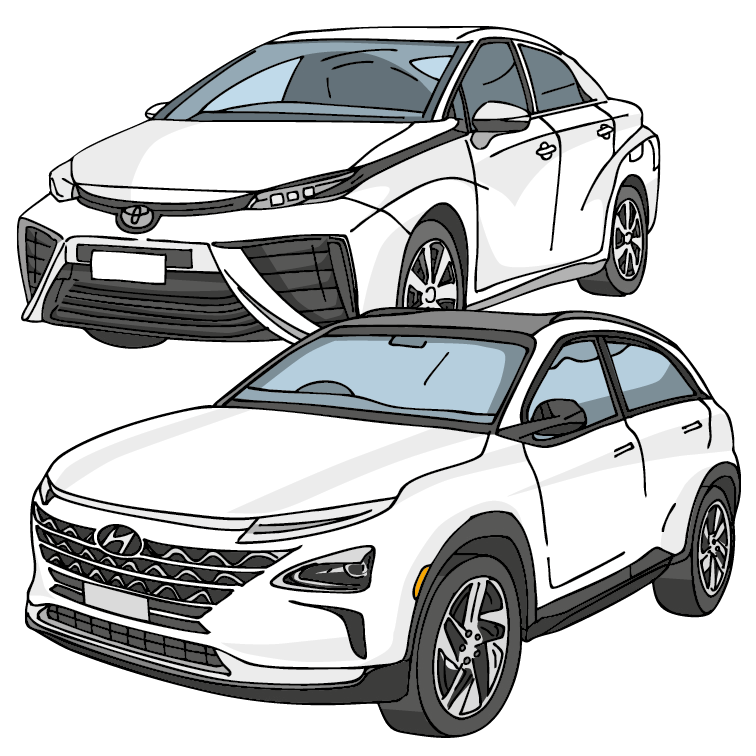
Specification
Comparable Fleet-Planning Data | |||
|---|---|---|---|
| Vehicle class | Passenger car | New Zealand status | Limited rental and evaluation fleet |
| Calculator status | Ready — published test-cycle default | Default hydrogen use | 0.89 kg/100 km |
| Hydrogen-use basis | Upper end of published combined consumption | Data confidence | Comparable laboratory result; verify against route use |
| Usable hydrogen | 5.6 kg | Storage pressure | 700 bar |
| Published range | Approximately 650 km; Toyota NZ states more than 640 km | Range basis | Market and test-cycle dependent |
| Refuelling time | Approximately 3–5 minutes | Tailpipe emissions | Water and water vapour |
Powertrain and Vehicle | |||
| Fuel cell output | 128 kW | Battery | Lithium-ion, approximately 1.24 kWh nominal |
| Motor output | 134 kW | Maximum motor torque | 300 Nm |
| Hydrogen tanks | 3 | Passenger capacity | 5 |
| Kerb mass | Approximately 1,900–1,950 kg | Towing | Not permitted |
Calculator Inputs Supplied by the User | |||
| Vehicle quantity | User input | Distance per vehicle | User input in km/day or km/week |
| Operating days | User input | Fleet reserve | User input; applied separately |
Evidence and Notes
Using This Profile
The default is the conservative end of Toyota's published combined consumption range. Actual fleet demand will depend on speed, temperature, traffic, passenger load and driving style.
Source data checked 17 September 2026.